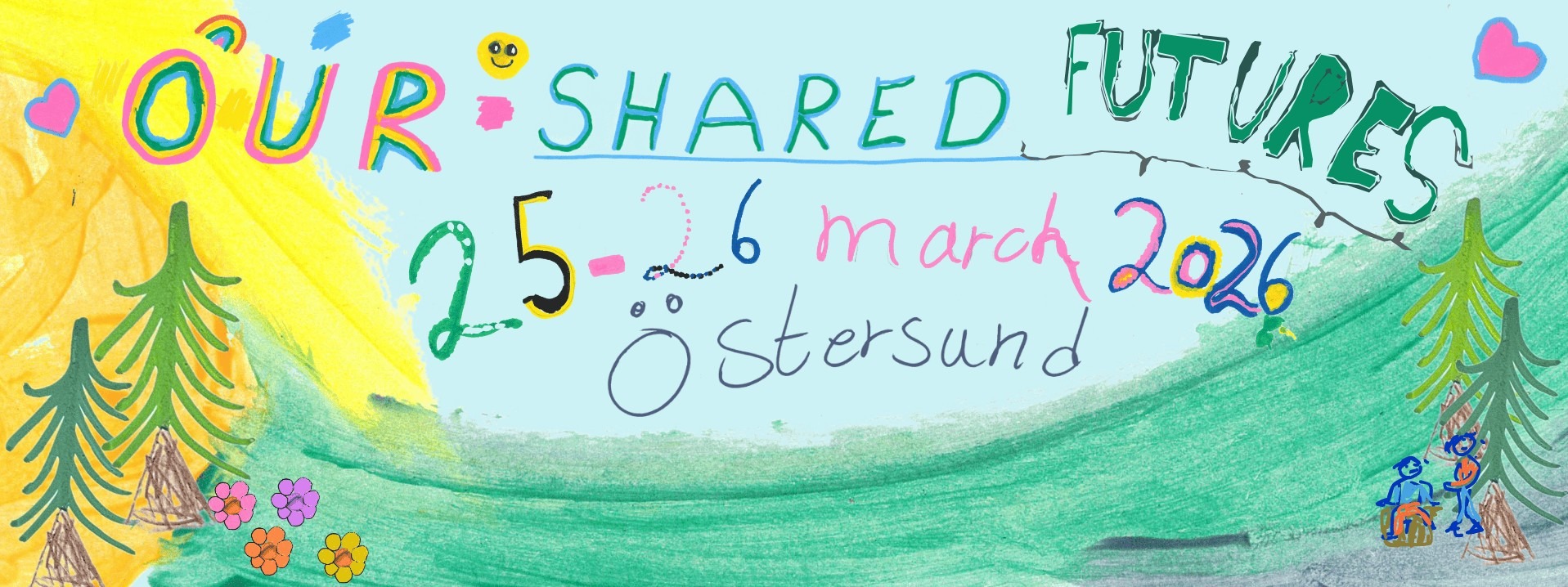
Our Shared Futures Conference cover image

Our Shared Futures Conference

March 25 – 26, 2026
Östersund, Sweden
832 56 Östersund Jamtland County, Sweden
Register

Welcome!!!

This is a conference for people who want to build a community for the future.

People who recognize that our greatest strength lies in our shared commitment to make a better future for all.


Our Shared Futures is organized by the DACCHE project, a three-year international collaboration exploring the role of heritage, culture, and local knowledge in times of climate change.

Come and join us!

A Conference like no other

What this conference is about?

Across two days, we’ll come together to explore a central question:

How do we build a community for the future?

Because the challenges of our time cannot be solved by single individuals. And they cannot be solved by institutions working in isolation.

They require shared responsibility.

This conference is about how heritage organisations, communities, and cultural actors can actively shape our shared future, not as observers, but as participants in it.

We will explore:

  • How heritage organisations can play an active role in climate dialogue (Heritage Path)

  • How local knowledge helps communities respond to environmental change (Community Path)

  • How cultural landscapes are being protected, transformed, or redefined (Climate Path)

  • How digital tools can support meaningful storytelling about place, change, and responsibility (Digital Path)

It’s about real places, and real tensions communities are already facing.

How the conference works

For two days, you’ll take part in a carefully designed gathering that blends:

  • Conversations and keynotes

  • Workshops and immersive heritage experiences

  • XR moments and storytelling

  • Youth voices, local perspectives, and decision-makers in the same room

You’re not attending as an audience member.
You’re joining as a participant.

This is a space where people from different disciplines, generations, and roles meet on equal ground to think together, and sometimes disagree productively.

Why attend?

  • Be part of the work, not the audience.
    You’ll be needed, in the conversations and the making.

  • Think with people you don’t usually meet.
    A rare mix that sharpens ideas and challenges assumptions.

  • Leave with clarity, not just inspiration.
    Stronger frames, better language, real direction.

  • Learn by doing.
    Workshops, XR experiences, immersive heritage, and real-world voices, big questions made tangible.

Registration

Participation is free, but places are limited.
Deadline for registration is March 20th.
Maximum capacity: 100 participants.

If these questions matter to you, we encourage you to register and join the conversation.

Program

A two-day experience designed to turn conversation into momentum, so better futures don’t stay hypothetical.

Open and Welcome by Organizers

Open & Welcome
The first shared moment and the official welcome to the conference.

Museum Interactive Visit Jamtli Grounds

Participants divided in 4 groups explore the live museum area at Jamtli.
Participants are invited to look for signs of heritage, resilience, and change embedded in buildings, landscapes, and everyday details.
*Fika will be provided at the Museum Cafe.

Keynote Speaker: Kristina Persson

What role does cultural heritage play for successful green transition?
Kristina, born and raised in Jämtland, is a Swedish economist and a former Social Democratic politician known for her long-term work on sustainable development, strategic future policy, and Nordic cooperation. She served as Sweden’s Minister for Strategic Development and Nordic Cooperation in the government of Stefan Löfven from 2014 to 2016, where she focused on long-range policy, green transition, and international collaboration. Before that she was a Member of Parliament and the European Parliament, county governor of Jämtland, deputy governor of Sweden’s central bank, and founded the independent think-tank Global Challengesto advance sustainability and future-oriented dialogue. Kristina has worked 18 years in Swedish and international trade union cooperation.

Kristina will speak about the necessity to build upon the social and cultural heritage in order to meet long-term challenges in relation to climate transformation and democracy

Keynote Speaker: Øystein Viem

Øystein Viem grew up on a family farm in Snåsa, Trøndelag, where craftsmanship, nature, and history were part of everyday life. From blacksmithing and woodworking to hunting and herding in the mountains, his early years shaped a deep connection to cultural heritage, not as theory, but as lived practice.

Today, he works at Stiklestad Nasjonale Kultursenter, bringing history and traditional craftsmanship to life. Trained as a product designer and educator, Øystein has taught arts and crafts, created sculptures in materials ranging from wood and steel to ice and horn, illustrated books, and designed exhibitions,  most recently completing a children’s altar cabinet for Nidaros Cathedral in Trondheim.

For him, heritage is something we shape with our hands, and carry forward.


DACCHE TEAM: From Learning to Intention

Kevin Denham, Helena Kuhlefelt, Andrew Brownridge, Judith McCarthy, Håvard Sørli

This session distills the DACCHE journey into seven objects and seven essential learnings, revealing the depth and richness of the project over the past two years.

From understanding that the essential is often invisible, to recognizing technology as a bridge, culture and nature as inseparable, and youth as authors of the future, we reflect on what we have discovered, and what it now asks of us.
These learnings invite participants to clarify their intention for tomorrow’s conference,  and beyond, through five personal development lenses: Being, Thinking, Relating, Collaborating, and Acting.

The Four Paths of Exploration

Our conference unfolds across four interconnected themes: Heritage · Communities · Climate · Digital. Each path offers a lens to explore our shared futures, what we preserve, how we belong, what is changing, and how technology shapes our future.

Using the QR code, participants are invited to leave an early signal of attention for Day 2, indicating which path feels most urgent or relevant to you.

Food, and MIngle

We'll relax and continue the conversations started during the 1st day of the conference with some food in hand and a mind full of inspiration. If you decide to stay and enjoy our hospitality, we will be done by 20:30.

Keynote Speaker: Hanna Mellemsetter PhD

Museums were not created to preserve the past. They were created to shape a future.
(b. 1959) from Trondheim, Norway is a historian and former Head of Collections and Research at Museene Arven. Mellemsether holds a PhD in history from the Norwegian University of Science and Technology (NTNU), has served as project manager for the Norwegian Deaf Museum, and worked as a senior adviser in the R&D unit of the Museums of South Trøndelag. She is particularly engaged in questions concerning accessibility for all and the social relevance of cultural institutions. Mellemsether has extensive experience from both national and international museum work.


Keynote Speaker: Daniel Slungård

Immersive Storytelling 
In this session, Daniel Slungård will explore how extended reality (XR) technologies can bring cultural heritage to life in powerful new ways. Through immersive storytelling, he has created digital experiences that make Sámi culture tangible, emotional, and present, not as something from the past, but as a living narrative shaped by memory, land, and identity.

His talk will demonstrate how emerging technologies, when used with care and respect, can deepen our understanding of indigenous knowledge, strengthen cultural dialogue, and expand the ways we experience stories about place and belonging.


4 Paths Skills Workshops

You’ll choose three of four hands-on workshop paths: 
Storytelling; learn to tell stories
Heritage; explore creative ways to protect what connects us
Climate; train your attention to notice how landscapes change, 
and Digital; use digital tools to connect.

Lunch

Sit at themed tables and connect across perspectives, guided prompts included.

Energisers

Short playful activities to reconnect the room and build momentum.

Keynote Speaker: Anders Hansson

Landscape as an idea
Anthropologist Anders Hansson will speak about his experience working in landscapes.
How can one fairly describe a landscape that has had completely different meanings for different people at different times? The road to that end is lined with personal considerations and the elimination of things we deem irrelevant. There are also things that simply do not fit into the description, or things that we do not understand. Every landscape has so many dimensions that it can never be described in its entirety. So what do we do when we study landscapes and try to create a story? With examples from the Jämtland mountain world, the landscape as an idea and how to understand it are discussed.


Keynote Speaker: Kate Robb

Kate Robb is a community archaeologist based in County Donegal, Ireland, who works at the intersection of heritage, climate adaptation, and community empowerment. After years guiding cultural heritage practice within development projects, she now collaborates directly with farmers, local heritage groups, and young people to deliver innovative conservation initiatives.

Her work focuses on strengthening heritage identity as a foundation for learning, wellbeing, and social resilience. In her talk, Kate will explore what “heritage communities” truly mean and how knowledge-sharing and cultural engagement can build stronger, more climate-resilient societies

Keynote Speakers: Alex Adsten & Pelle Vykander — The Future, In Their Own Words

What does the future look like through the eyes of those who will live it?
In this session, 16-year-old students Alex Adsten and Pelle Vykander take the stage to share their visions, concerns, needs, and hopes for the years ahead. Speaking not as representatives of institutions but as young citizens, they offer an honest perspective on climate, community, technology, identity, and belonging.This conversation invites us to listen, not to respond, defend, or explain,  but to understand what the next generation is asking for, and what kind of future they are ready to help shape

Storytelling Immersive Experience

You'll get to pick one of two storutelling workshops, one focused on the future and the other in thye past. 

The Museum of the Future: Step into possible futures and explore what they ask of us.

The Cabinet of Wonders: Objects, stories, and meaning, an intimate experience of heritage as something alive.

Collective Reflection From Insight to Intention

From conversation to intention. What do we carry forward?
Participants are invited to upload to a virtual wall their reflection points:

  • Ritual Wall
  • Pledge Board
  • The Sound of Change
  • Future Messages Booth
Closing Ritual

Collective reflection and formal closing of the conference.
“A postcard to the future.”

Co-Financed by

The project is funded with support from EU Interreg NPA (Northern Periphery and Arctic) Programme, Region Jämtland Härjedalen, Trøndelag fylkeskommune, and Donegal County Council.

Interreg NPA
Interreg NPA
Jämtland Härjedalen
Jämtland Härjedalen
Trøndelag fylkeskommune
Donegal County Council

Partners

Jamtli Museum
Jamtli Museum
Museene Arven
Museene Arven
Donegal County Museum
Tindved
Tindved
Nord Universitet
Nord Universitet
NCK
NCK

A sustainable, accessible and inclusive event

We’re working to minimise the conference’s environmental impact while maximising its social value: locally sourced food, handmade local artwork for the conference identity, and as little printing and disposable material as possible.

Our Shared Futures is designed to be inclusive, accessible, and respectful, bringing different disciplines, roles, languages, and lived experiences together on equal footing.

We’ll share practical access and venue details in advance to make participation as easy as possible for everyone.

March 25 – 26, 2026
Östersund, Sweden
832 56 Östersund Jamtland County, Sweden